What a flat-plate solar collector is
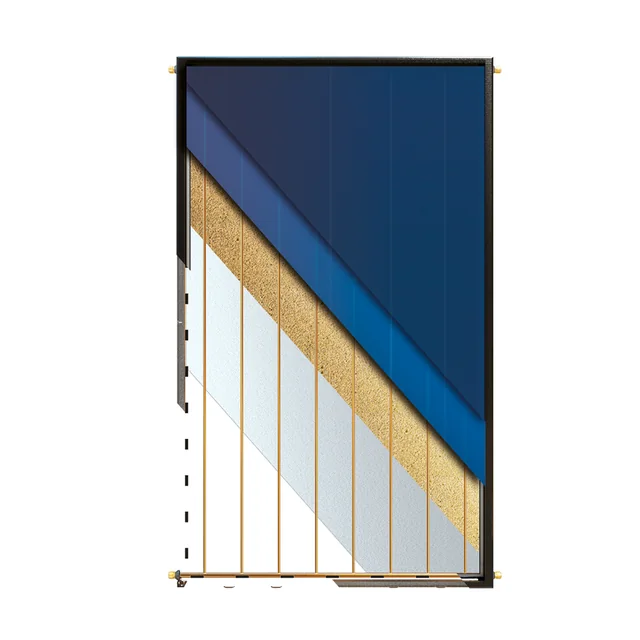
A flat-plate solar collector is an insulated, glazed box containing a dark absorber plate with fluid channels; sunlight heats the absorber and a pump or natural convection carries the heat to a storage tank. It is the most widely used solar thermal technology worldwide, with peak efficiencies of 75–82 % at domestic hot water temperatures, and it dominates markets such as Türkiye, Greece, Brazil and Central Europe.
The absorber and its selective coating
The absorber is a sheet of copper or aluminium bonded to copper tubes in a harp (parallel risers) or meander layout by laser or ultrasonic welding. A selective coating deposited by vacuum sputtering (PVD) gives it a solar absorptance of about 95 % and a thermal emittance of 5 % or less, so it captures sunlight efficiently but radiates little heat back. Older black-paint coatings absorb well but emit far more; a good selective absorber raises output noticeably at higher temperatures and in winter.
Full-surface absorbers welded to meander pipes give uniform flow and low pressure drop, which matters for large fields; harp designs suit thermosiphon systems where natural circulation needs minimal resistance.
Glazing, insulation and casing
The cover is 3.2–4 mm low-iron tempered solar glass with about 91 % transmittance, or 95–96 % with an anti-reflective coating; it must survive hail (tested with 25 mm ice balls under ISO 9806) and thermal shock. Behind the absorber, 40–60 mm of mineral wool limits back losses; the frame is aluminium with an EPDM gasket and a stable back sheet. Stagnation temperatures of 180–220 °C occur when no heat is drawn off, so all materials and the heat-transfer fluid must tolerate them.
Reading the performance figures
Collector datasheets and Solar Keymark certificates give three coefficients from ISO 9806 testing: peak (optical) efficiency η0, and heat-loss coefficients a1 (W/m²K) and a2 (W/m²K²). Good flat plates reach η0 of 0.75–0.82 with a1 around 3–4 W/m²K. Efficiency falls as the difference between fluid and ambient temperature grows, so the same collector performs better for pool or preheat duty than for 60 °C hot water.
Check whether figures refer to aperture area (the transparent opening) or gross area (outer dimensions); Solar Keymark certificates now use gross area, which yields lower coefficients for the same collector. Certificates also state annual output per collector for reference locations — Athens, Würzburg, Davos and Stockholm — at mean fluid temperatures of 25 °C, 50 °C and 75 °C, which is the most useful single figure for comparing products.
What Solar Keymark certifies
Solar Keymark is the voluntary European quality mark for solar thermal collectors and factory-made systems, owned by CEN and administered by the Solar Keymark Network. It requires testing at an accredited laboratory to EN 12975 / ISO 9806 (collectors) or EN 12976 (systems), covering performance, durability, pressure, exposure, rain penetration, hail and mechanical load, plus annual factory inspections by an empowered certification body. Most European subsidy schemes and many tenders in the Middle East and Africa accept only Keymark-listed products, and the public database at solarkeymark.eu lists every valid certificate.
Frost, overheating and drainback
In climates with frost, the collector loop is filled with a propylene glycol mixture (typically 30–45 %) and protected by an expansion vessel sized to hold the entire collector volume during stagnation. A drainback system takes a different route: when the pump stops, the collector fluid drains by gravity into a reservoir, leaving the collectors empty. This avoids freezing and stagnation stress, allows plain water instead of glycol and simply stops collecting when the tank is full — a strong advantage in hot climates and for holiday homes. Drainback needs pipes that slope continuously towards the reservoir and a pump able to lift the fluid to the top of the collector on start-up.
Flat plate or evacuated tube?
Evacuated tubes lose less heat at high temperatures and in cold, windy conditions, but flat plates are cheaper per kWh in most hot-water applications, more robust, easier to integrate on roofs and available as thermosiphon packages. For process heat above 80 °C or very cold climates, tubes gain ground; for domestic and commercial hot water from Central Europe to the Gulf, the flat plate remains the workhorse.
Frequently asked questions
What temperature does a flat-plate collector reach?
In normal operation a flat-plate collector delivers 40–80 °C to the storage tank. If no heat is drawn off, the absorber can reach a stagnation temperature of 180–220 °C, which is why the fluid, seals and expansion vessel must be rated for it.
Is Solar Keymark required to sell collectors in Europe?
It is not a legal requirement for CE marking, but most European subsidy programmes and many public tenders demand it, and it is the accepted proof of ISO 9806 performance data. Buyers should check the certificate in the public Solar Keymark database.
What is a drainback solar system?
A drainback system lets the collector fluid drain into a reservoir whenever the pump stops, so the collectors are empty when idle. It protects against freezing and overheating without glycol, provided the pipework slopes continuously back to the reservoir.
How much collector area does a family need?
Roughly 1–1.5 m² of aperture area per person in Southern Europe and the Middle East, and 1.5–2 m² in Central Europe, with 50–70 L of storage per m². Two collectors of about 2 m² each with a 300 L tank typically cover 60–70 % of a four-person household's hot water in Central Europe and more in the south.