Why the tank matters as much as the heat source
A heat pump or solar system only performs as well as the store it charges. The tank determines how much hot water is available at peak, how much heat is lost overnight, whether the heat pump can run in long efficient cycles and how hygienic the drinking water remains. Choosing between an enamel cylinder, a stainless-steel or hygienic tank, a buffer and a combi (tank-in-tank) unit is therefore a system decision, not a commodity purchase.
Enamel-lined DHW cylinders
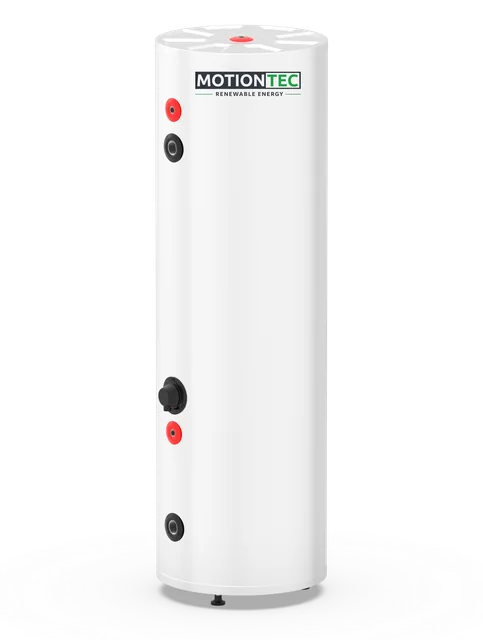
An enamel tank is a carbon-steel pressure vessel with a glass-like enamel layer fused to the inside at around 850 °C, protecting the steel from potable water. Corrosion protection at pores and welds comes from a sacrificial magnesium anode or a maintenance-free impressed-current (titanium) anode. Standards such as DIN 4753-3 define enamel quality; the anode should be checked every one to two years and replaced when consumed.
Enamel cylinders are the cost-effective standard for direct hot water storage with one or two internal coils. For heat pumps, specify a large coil — as a rule 0.25–0.3 m² of coil surface per kW of heat pump output, or at least 3 m² for a typical residential unit — because the low flow temperature needs more surface to transfer the heat.
Stainless-steel and hygienic tanks
Stainless steel (typically 316L or duplex grades) resists corrosion without an anode and suits soft or aggressive water, but costs more and is sensitive to high chloride levels. A hygienic tank takes a different approach to hygiene altogether: it stores heating water, not drinking water, and heats potable water instantaneously as it flows through a long corrugated stainless-steel coil — usually 3–8 m² of surface — immersed in the tank.
Because only a few litres of drinking water are held in the coil at any time, the risk of Legionella growth is minimal, and the tank can be run at lower temperatures — often 50–55 °C in the upper zone — which favours heat pump and solar efficiency. A fresh-water station uses an external plate heat exchanger and pump to do the same job at higher draw-off rates.
Buffer tanks for heating water
A buffer tank stores heating water only. It gives a heat pump the water volume it needs for defrost cycles and for a minimum run time of 6–10 minutes per cycle, decouples the heat pump flow from zoned emitter circuits (hydraulic separation) and can accept heat from solar, wood or an electric element. Typical sizing is 15–25 L per kW of heat pump output for decoupling, and considerably more — 50 L per kW or above — where the buffer must bridge time-of-use tariffs or feed radiator zones that shut off individually.
Look for diffusers that preserve stratification, several connection heights and thick insulation — 100 mm of PU foam or fibre-free soft foam — so standing losses stay low.
Combi tanks (tank-in-tank)
A combi tank places a smaller drinking-water tank inside a larger buffer volume. The inner tank — enamel or stainless steel — is heated by the surrounding heating water, while the buffer can be charged by heat pump, boiler or a solar coil. It combines DHW and buffer in one footprint, which suits compact plant rooms and single-family systems with solar support. The drawbacks are a fixed ratio between DHW and buffer volume, and stored drinking water that still needs periodic heating to 60 °C for hygiene.
Sizing quick guide
- Domestic hot water: 30–50 L per person per day at 60 °C; a family of four is usually served by 200–300 L with a heat pump.
- Solar DHW: 50–70 L of storage per m² of collector aperture area.
- Heat pump buffer: 15–25 L per kW for hydraulic decoupling; 50 L per kW or more for storage.
- Coil surface for heat pumps: 0.25–0.3 m² per kW.
- Legionella: keep stored drinking water at 60 °C at the tank outlet and at least 55 °C in circulation, or use hygienic or fresh-water storage.
Checklist before you order
Confirm the working pressure (6 or 10 bar for DHW, usually 3 bar for buffers), test pressure and connection sizes. Ask for the ErP standing-loss class under Regulation (EU) 812/2013 and the loss figure in watts. Request a drawing with connection heights, the coil surface in m² and the anode type. Check the tank height against the plant-room door, and for large commercial vessels confirm the Pressure Equipment Directive category. Finally, match the tank to the heat source: large coils or hygienic designs for heat pumps, a low solar coil for collectors, and enough buffer volume for the control strategy.
Frequently asked questions
What is a hygienic tank?
A hygienic tank stores heating water and heats drinking water instantaneously in a corrugated stainless-steel coil, so almost no potable water is stored. This minimises Legionella risk and lets heat pumps and solar systems run at lower, more efficient temperatures.
How big should a buffer tank be for a heat pump?
For hydraulic decoupling and defrost, 15–25 L per kW of heat pump output is typical; a 10 kW unit needs about 150–250 L. Where the buffer must store heat for tariff shifting or solar input, plan 50 L per kW or more.
Enamel or stainless steel — which lasts longer?
Both can last 15–20 years or more. Enamel with a maintained magnesium or impressed-current anode is cost-effective and tolerant of most water qualities; stainless steel needs no anode but is sensitive to high chloride levels.
Does a hygienic tank need to reach 60 °C?
No. Because drinking water is not stored, the heating water can be held at 50–55 °C in the upper zone; the outlet temperature is set by mixing. National codes may still require 55–60 °C in circulation pipework.