What an air-to-water heat pump is
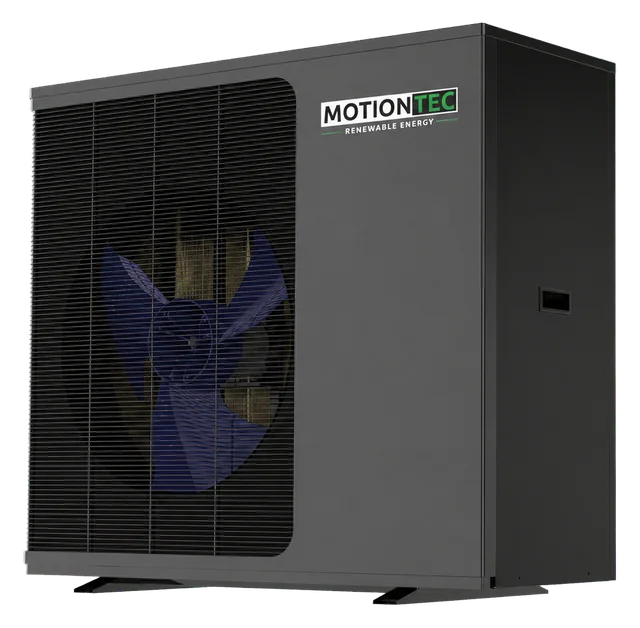
An air-to-water heat pump is an electrically driven heating appliance that extracts heat from outdoor air and transfers it to water circulating in a building's radiators, underfloor heating or hot water cylinder. Because it moves existing heat rather than generating it by combustion, it can deliver 3–5 kWh of heat for every 1 kWh of electricity it consumes.
The technology works even when the air feels cold. Air at −10 °C still contains a large amount of thermal energy relative to the refrigerant, which boils well below that temperature. Modern inverter units keep operating down to −20 °C to −25 °C, although output and efficiency fall as it gets colder.
The refrigerant cycle in four steps
- Evaporator: a fan draws outdoor air over a finned coil; the cold liquid refrigerant inside absorbs heat and evaporates.
- Compressor: the vapour is compressed, which raises its pressure and temperature well above the heating-water temperature.
- Condenser (plate heat exchanger): the hot vapour gives up its heat to the heating water and condenses back to a liquid.
- Expansion valve: the pressure drops, the refrigerant cools sharply and the cycle starts again.
In winter, frost forms on the evaporator when outdoor air is humid and below about 5 °C. The unit periodically reverses the cycle for a few minutes to melt it; this defrost energy is already included in seasonal efficiency figures.
Monoblock or split?
A monoblock heat pump contains the whole refrigerant circuit in the outdoor unit; only insulated water pipes enter the building. It is factory-sealed, needs no refrigerant handling on site and is the natural format for propane (R290) units. A split system places the condenser indoors and connects the two halves with refrigerant lines, which requires certified refrigerant work during installation.
For export projects, monoblocks simplify logistics and commissioning; splits are still chosen where the water circuit cannot be protected against freezing during long power cuts.
COP: efficiency at one operating point
COP (coefficient of performance) is the ratio of heat output to electrical input measured at a single, standardised condition. In Europe the test method is EN 14511, and the condition is written as air temperature / water outlet temperature — for example A7/W35 means 7 °C outdoor air and 35 °C flow temperature.
Typical values for a current inverter monoblock: COP 4.5–5.2 at A7/W35, 3.5–4.2 at A2/W35, 2.6–3.2 at A−7/W35, and around 2.8–3.5 at A7/W55. Always compare units at the same test point; a headline COP quoted at A20/W35 says little about winter performance.
SCOP and the ErP energy label
SCOP (seasonal coefficient of performance) is calculated under EN 14825 by weighting part-load tests across a full heating season, including defrost and standby consumption. It is quoted for three reference climates — average (Strasbourg), warmer (Athens) and colder (Helsinki) — and for a low-temperature (35 °C) or medium-temperature (55 °C) application.
The ErP label converts SCOP into seasonal space heating efficiency, ηs: roughly SCOP divided by 2.5 (the EU primary energy factor), minus small deductions for controls and pumps. Under Regulation (EU) 811/2013 the classes run from A+++ (ηs ≥ 150 %) to D. A SCOP of about 3.9–4.0 earns A+++, and good residential units now reach SCOP 4.5–5.0 at 35 °C in the average climate. The European Commission has proposed rescaling the label to a simple A–G scale, so check which label version a datasheet refers to.
What to check on a datasheet
- Heating capacity and COP at A7/W35, A2/W35 and A−7/W35 — not only the best point.
- SCOP and ηs for your climate zone at the flow temperature your emitters need.
- Maximum flow temperature: about 60–65 °C for R32, up to 75 °C for R290, which matters for hot water and radiator retrofits.
- Sound power level in dB(A) to EN 12102, not sound pressure at 5 m.
- Operating range: the lowest outdoor temperature at which full heating and hot water are still available.
- Refrigerant type, charge in kg and GWP.
Getting the efficiency the label promises
Real-world performance depends more on system design than on the compressor. Every 1 K reduction in flow temperature improves efficiency by roughly 2–3 %, so generously sized radiators, underfloor heating and weather-compensated control pay for themselves. Size the unit for the building's design heat load rather than the old boiler rating, keep pipe runs short and insulated, and add a buffer tank or hydraulic separator only when the emitter circuits cannot guarantee minimum flow.
Frequently asked questions
What is a good COP for an air-to-water heat pump?
A COP of 4.5 or higher at A7/W35 is a strong result for a modern inverter monoblock, and 2.6–3.2 at A−7/W35 is normal. Always compare units at the same EN 14511 test point.
What is the difference between COP and SCOP?
COP is measured at one steady operating condition, while SCOP is the seasonal average calculated under EN 14825 across a whole heating season, including part load and defrost. SCOP is the better guide to running costs.
Do air-to-water heat pumps work below freezing?
Yes. Modern units keep heating down to −20 °C to −25 °C, with reduced capacity and COP. Sizing at the local design temperature and choosing a unit with a low bivalent point keeps backup heater use to a minimum.
What SCOP is needed for the A+++ label?
Roughly SCOP 3.9–4.0 or higher, which corresponds to a seasonal space heating efficiency (ηs) of 150 % under the current EU label. Most new R290 and R32 inverter units reach A+++ at 35 °C flow temperature.